Tatarian Honeysuckle
Differs from edible honeysuckle: the berries of this species are poisonous!
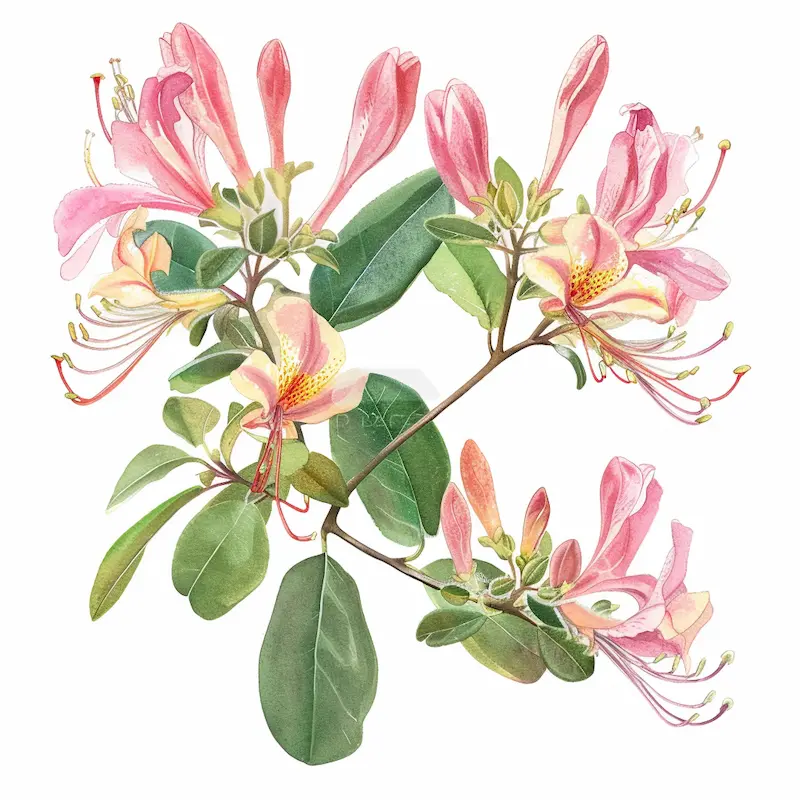
Tatarian Honeysuckle is one of the most attractive ornamental shrubs for the Ukrainian garden and continues to enjoy popularity despite being cultivated in Europe and North America since the nineteenth century. It originates from the southern regions of Russia and Kazakhstan, where it thrives in natural conditions as an undemanding and resilient plant. This very adaptability has made Tatarian Honeysuckle a favourite among gardeners worldwide — it establishes readily almost anywhere.
This shrub impresses with its striking beauty during the flowering period. From May through June, its branches become covered with delicate paired flowers that may be soft pink, white, or bicoloured, depending on the cultivar. Following flowering, bright red (occasionally yellow) berries appear, further enhancing the ornamental effect. The most popular varieties are 'Arnold Red' with intensely coloured red flowers and 'Hack's Red' with large fruits.
In the garden, Tatarian Honeysuckle demonstrates remarkable versatility. It can be planted as a specimen shrub or combined with viburnum, elder, and rowan. It performs excellently in hedging, as it branches densely and tolerates pruning readily. The shrub attracts birds and insects, making it a favourite among gardeners who care about biodiversity and ecosystem health on their plots.
One crucial point must be noted: the berries of this honeysuckle are TOXIC and unsuitable for consumption, unlike the edible blue honeysuckle. Therefore, it is important to distinguish between these two species, especially if children are present in the household. This does not diminish its value as an ornamental plant — rather, it makes it even more interesting for observing wildlife in the garden.
Tatarian Honeysuckle — planting & location
Bright red berries follow flowering (poisonous!)
How to water Tatarian Honeysuckle
Drought-tolerant once established
Fertilizing and pruning: Tatarian Honeysuckle
Remove old branches and crossing growth