Tulip
In the 17th century, a single tulip bulb cost as much as a town house in Amsterdam.
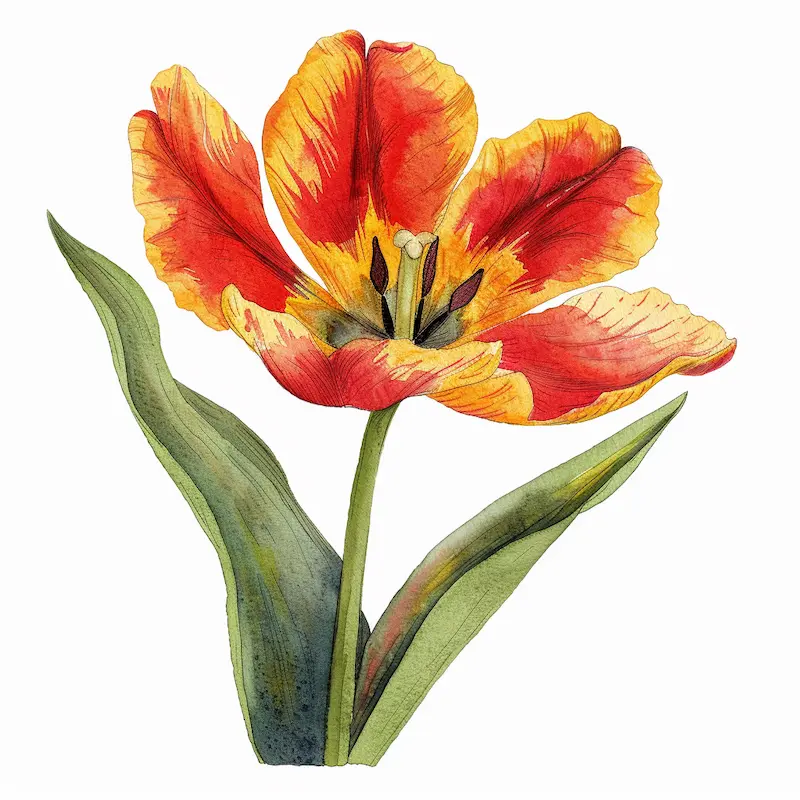
The garden tulip is among the world's most beloved flowers, and with good reason. Originating from mountainous regions of Central Asia, it arrived in Europe during the sixteenth century and immediately captured the hearts of plant breeders. The modern garden form Tulipa × gesneriana is the result of centuries of work by Dutch horticulturists, who created a remarkable spectrum of colours and forms, from classic reds to exotic blacks, striped and double varieties.
The tulip's appearance is deceptively simple, yet therein lies its entire charm. Smooth, richly coloured petals form an elegant cup or goblet that opens wide on sunny days. The foliage—long, narrow, and glaucous—performs its function discreetly before fading away like a supporting actor. The palette ranges from pure white to deep violet, from brilliant yellow to nearly black. Hybrid forms offer two-toned combinations, stripes, double blooms, and even flowers with fringed petal edges.
In the garden, tulips are the first actors on spring's stage. They are ideal for rows along pathways, compact group plantings in front of houses, or as part of mixed borders with daffodils and crocuses. Each year, bulbs should be dug up in summer and stored in a cool place—a simple yet essential annual routine that guarantees strong flowering in the following season. Early, mid-season, and late varieties extend the display from April through May.
Yet legend surrounds tulips with an aura of romance and mystery. In the seventeenth century, during the famous 'Tulip Mania' in Holland, a single bulb of a rare variety could cost as much as a townhouse. People pledged their fortunes, traded estates, and even committed fraud for one extraordinary flower. This was history's first speculative bubble, but it left behind something enduring—a profound love for this flower that has never faded.
Tulip — planting & location
Bulbous; bulbs should be lifted in summer.
How to water Tulip
Do not water after foliage yellows.
Fertilizing and pruning: Tulip
Remove foliage after yellowing.