White Mulberry
The silkworm is raised on the leaves of white mulberry—the foundation of the silk industry.
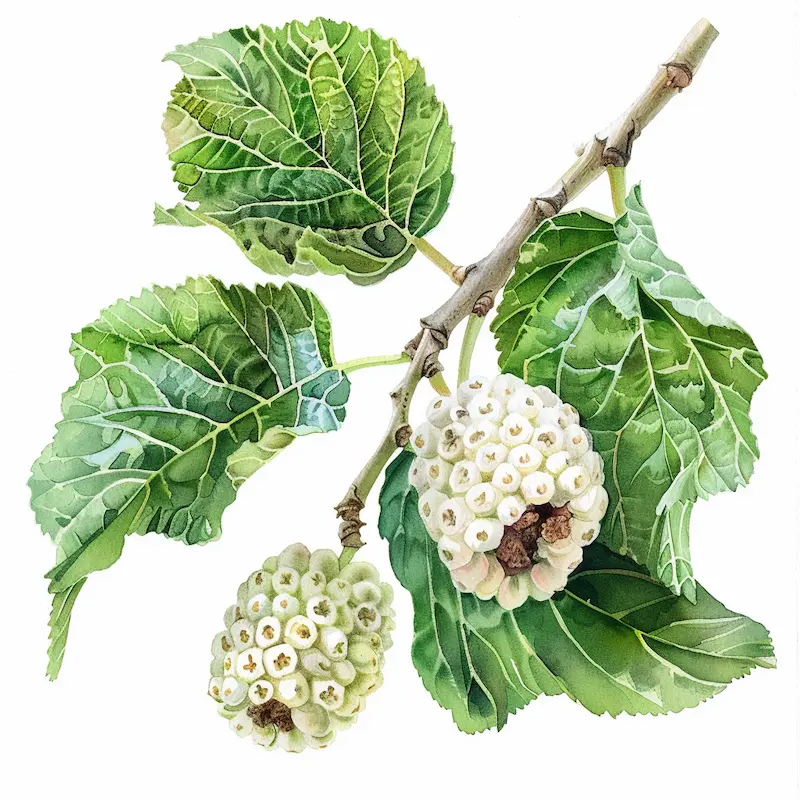
White Mulberry is one of the oldest cultivated fruit-bearing plants, originating from China and accompanying humanity for millennia. This marvellous gift from the East was introduced to Europe in ancient times and subsequently spread throughout the world. In Ukraine, white mulberry has thrived well, particularly in southern and central regions, where it yields abundant harvests of sweet berries and becomes a true ornament of gardens.
White mulberry impresses with its undemanding nature and generosity. Its leaves feature a characteristic heart-shaped form with fine hairs, and during the flowering period (May–June), the tree is covered with small flowers that attract little attention yet promise a generous crop. The berries change colour from white or pink to black as they ripen, acquiring a delightful sweet-tart flavour. Plant breeders have developed numerous cultivars—from compact forms suitable for small gardens to vigorous trees that become true long-lived specimens in family orchards.
In the garden, white mulberry is a versatile plant that pairs well with other fruit crops such as apple, pear, and plum. It serves as an excellent shade tree, provides elegant foliage for ornamental purposes, and most importantly, feeds the family with ripe berries year after year. Gardeners cherish white mulberry for its disease resistance and ability to thrive in virtually any soil.
The true magic of mulberry lies in its historical significance: for 5,000 years, the silkworm has been reared on the leaves of this tree, creating the most delicate natural material—silk. This is a connection between the plant world and human civilisation, worth remembering when you plant this tree in your garden.
White Mulberry — planting & location
Fast-growing, edible berries, silkworm host plant.
How to water White Mulberry
Water young trees regularly; mature trees are drought-tolerant.
Fertilizing and pruning: White Mulberry
Remove dead and diseased branches.