Scotch Broom
Broom is an allegory of rebirth: it flowers on old, decaying branches.
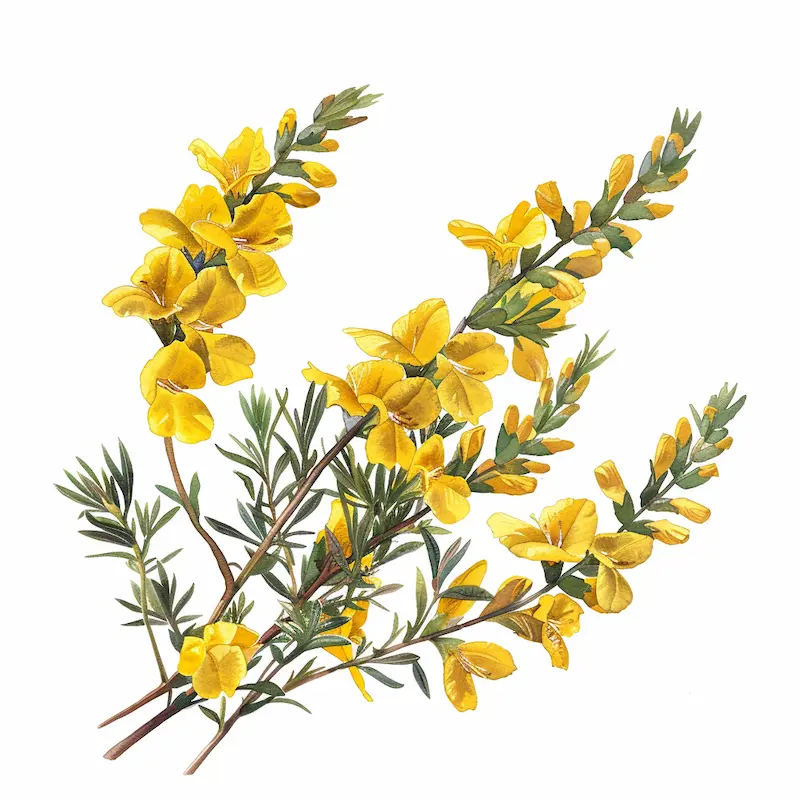
Scotch Broom is one of those shrubs that transforms a May garden into pure gold. Its slender, arching stems virtually disappear beneath a cloud of brilliant yellow butterfly-like flowers, and at this moment it is hard to believe that in winter the plant looks almost lifeless—grey, bare twigs without the faintest hint of foliage.
The native home of Scotch Broom is Western Europe, where it grows freely on sandy slopes, woodland edges and heathland moors. In Ukraine, it has become established as an ornamental plant, particularly valued in landscape plantings on poor and sloping sites where other plants refuse to grow. This is no accident: Scotch Broom belongs to the legume family and enriches the soil with nitrogen through root nodule bacteria—a true pioneer and soil improver in the plant world.
Beyond its beauty, Scotch Broom has practical value: its flexible shoots have long been used for basket-weaving and making brooms—hence the common name. In folk medicine, the plant is known for its diuretic properties, though nowadays it is more often planted for aesthetic appeal than for healing purposes.
In the garden, Scotch Broom combines well with conifers, heather and ornamental grasses. It grows rapidly and flowers abundantly by the second or third year after planting. The one thing it will not forgive is heavy waterlogged soil and transplanting at a mature age. Choose its location once and for all: the root system of Scotch Broom is sensitive to disturbance. After flowering, lightly trim the shoots—this maintains a compact form and encourages abundant flowering in the following season.
Scotch Broom — planting & location
Ornamental flowers, drought-tolerant, toxic.
How to water Scotch Broom
Drought-tolerant once established.
Fertilizing and pruning: Scotch Broom
Cut back shoots from the previous year to two-thirds after flowering.