Siberian Squill
Forms carpets of blue colour beneath trees
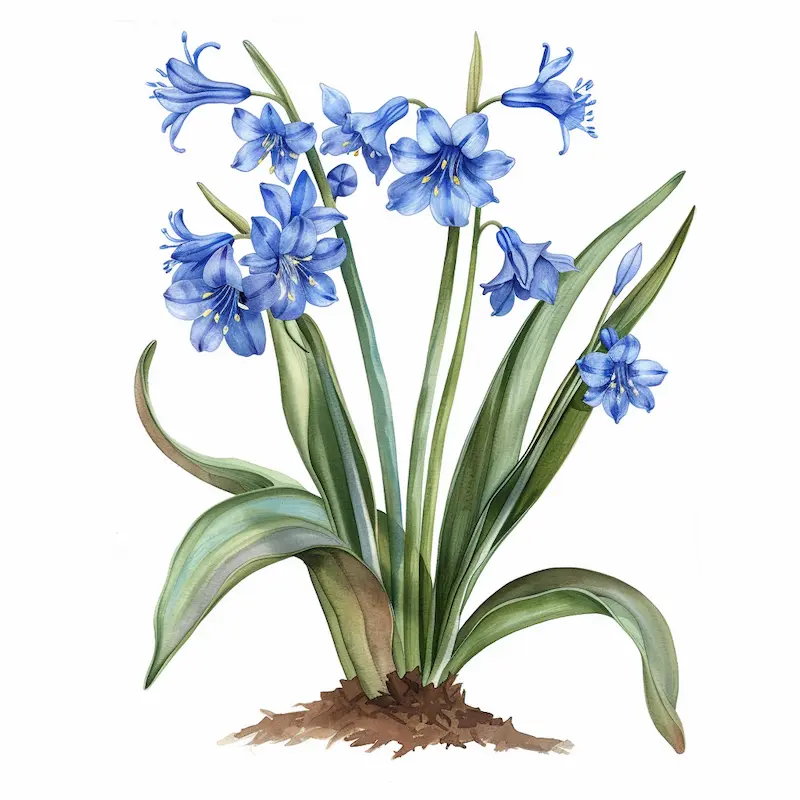
Siberian Squill is truly a spring queen, bestowing gardens with their first colours after the winter slumber. It originates from the steppes and mountainous regions of Southern Siberia and the Caucasus, where for centuries it has naturally formed luxurious blue carpets on hillsides. This delicate plant has been cultivated by people for over four centuries and has long become a favourite of European gardeners, who cherish it for its undemanding nature and reliability.
Externally, Siberian Squill is a small yet highly attractive plant. Fine linear leaves grow directly from the soil, while above them rise flowering stems bearing dense clusters of tiny bells. The most common variety displays a rich deep blue colouration of petals, yet gardeners can find light blue variants, and a white-flowering form will add contrast to compositions.
In the garden, Siberian Squill is simply indispensable—an ideal plant for naturalisation beneath the crowns of trees and shrubs, where spring provides sufficient light for flowering, whilst summer's thick leaf cover creates a comfortable semi-shade for the bulb. Remarkably, being undemanding regarding soil and climate, it thrives splendidly throughout all corners of Ukraine, from south to northern regions. Groups of Scilla planted in loose brushstrokes across the lawn or beneath fruit trees create an incredible effect of a natural meadow—that wild, organic appearance which modern gardeners so earnestly desire.
Most interestingly, Siberian Squill is among the very first spring heralds: when snow has not yet fully melted, its blue bells are already in bloom, providing bees and early insects with essential nectar. This is precisely why gardeners wishing to support natural biodiversity must surely find a place for this modest yet such bountiful plant of beauty.
Siberian Squill — planting & location
One of the earliest spring flowers
How to water Siberian Squill
Do not water after foliage dies back
Fertilizing and pruning: Siberian Squill
Foliage dies back naturally