Japanese Quince
The fruits contain five times more vitamin C than lemon.
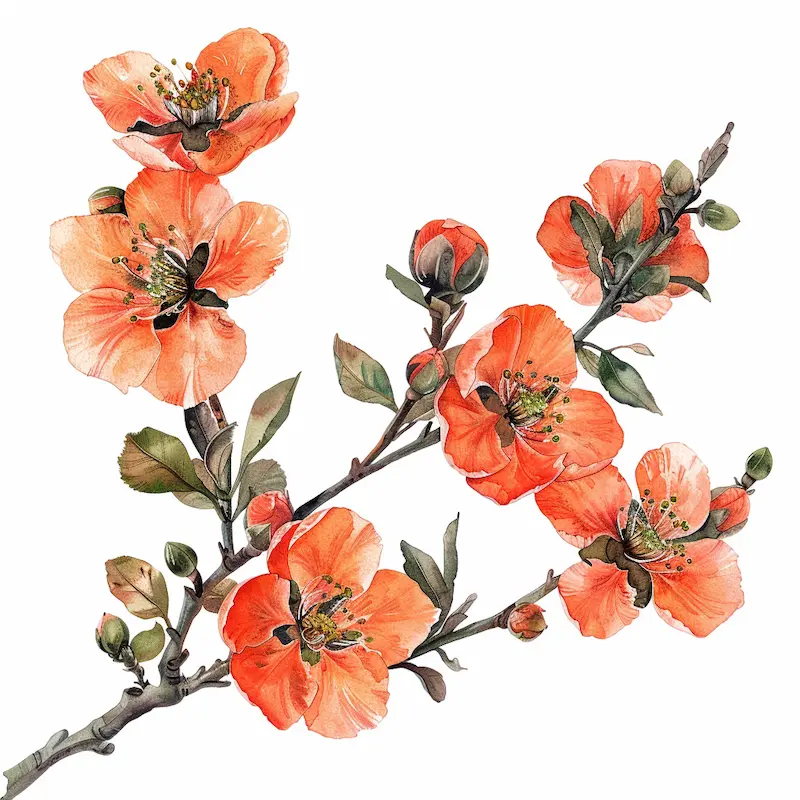
Japanese quince is one of the most cheerful harbingers of spring in the garden. This undemanding shrub, native to Japan and China, will become clothed in a dense veil of flowers before the leaves even unfurl: orange, red and white blooms flourish from April through May, bringing the first colour to the garden after a grey winter. Plant breeders have developed many interesting cultivars—from vibrant red 'Rubra' to delicate white 'Alba'—so every gardener will find a variety to their taste.
To the eye, Japanese quince is a compact and lively plant, entirely densely covered in sharp thorns and elongated leaves. Its typical height of 0.5–1.5 metres makes it ideal for both large beds and small gardens. Current year's shoots often display a dull brownish colouration, which adds particular appeal even during the dormant period. The flowers are simple or semi-double in form, and later in their place small, hard fruits appear, resembling tiny apples.
In the garden, Japanese quince is a universal helper. It combines beautifully with forsythia, steppe almond and dogwood, creating striking spring compositions. Interestingly, the fruits of this plant contain as much as five times more vitamin C than lemon! They are inedible raw due to their astringency, but they yield unforgettable jam, compote and marmalade, imparting an enchanting aroma and enhancing their nutritional value. The undemandingness of quince is its true strength: it thrives with moderate watering, develops in both sun and partial shade, and requires no complex care. This is precisely the plant that deserves a place in every garden.
Japanese Quince — planting & location
One of the earliest flowering plants of spring; fruits are edible (suitable for jam)
How to water Japanese Quince
Moderate watering
Fertilizing and pruning: Japanese Quince
Retain 5–7 main branches, remove the rest