Black chokeberry
The berries of black chokeberry lower blood pressure due to their anthocyanin content.
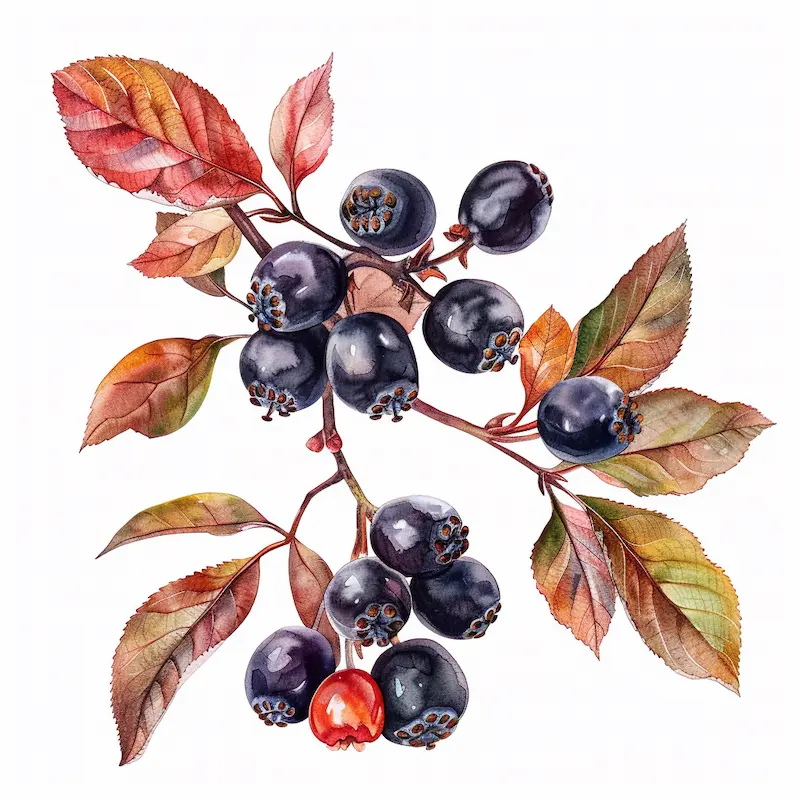
Black chokeberry is one of the most undemanding berry crops, originating from North American forests. For over a century, it has been beloved by gardeners worldwide, arriving in Ukraine in the late nineteenth century. Thanks to its hardiness and practicality, it quickly gained popularity and is now cultivated both in private gardens and on commercial plantations—a true 'working' plant that requires minimal attention yet delivers a bountiful harvest.
The black chokeberry shrub impresses with its grace through all seasons. In May, it blooms with delicate white flowers gathered into dense clusters, and in summer, it is adorned with bright red berries that gradually darken to a deep black colour. In autumn, the foliage takes on burgundy and maroon hues, creating a picturesque contrast with the black berries. Among the varieties, 'Hero' stands out for its more vigorous yield, and 'Brilliant' for its more striking autumn colouration.
In the garden, black chokeberry is a universal helper. It can be planted in hedgerows, used as a specimen on the lawn, or combined with other berry-bearing shrubs—viburnum, blackcurrant, and wild rose. The berries are not merely beautiful but also beneficial: they are rich in anthocyanins, which are renowned for their beneficial health properties. Gardeners readily use them for preserves, compotes, and fruit drinks.
Interestingly, the English name 'chokeberry' does not derive from any bitterness in the berries—they are soft and pleasantly flavoured. This name lingers from earlier species with an astringent taste. Modern black chokeberry is a cultivated variety that combines ornamental appeal, hardiness, and genuine utility. If you are seeking a plant that will work for you without particular fuss, then black chokeberry is exactly what you need.
Black chokeberry — planting & location
Edible berries, bright autumn foliage
How to water Black chokeberry
Moderate watering
Fertilizing and pruning: Black chokeberry
Remove old branches aged 5–6 years