Ninebark
One of the most undemanding ornamental shrubs for planting beneath trees.
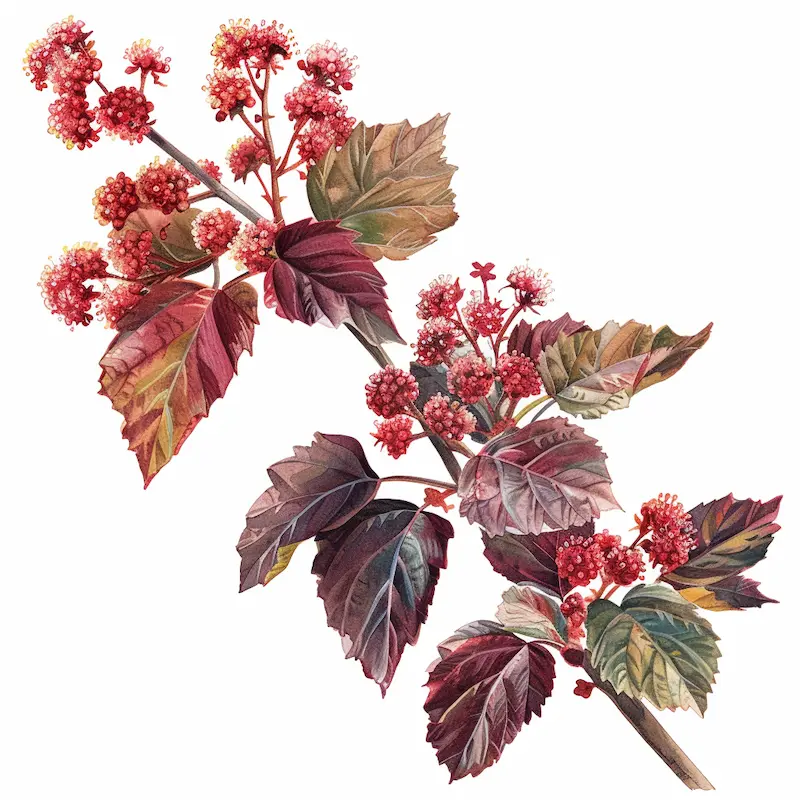
Ninebark is a graceful ornamental shrub native to North America that has long captured the hearts of European gardeners with its remarkable hardiness and distinctive character. It flowers in June with delicate blooms arranged in clusters, which transition in colour from white to a rich rose-pink. Yet the true beauty of this plant lies not in the flowers but in the foliage: depending on the variety, it can be deep burgundy, golden-yellow, or even almost black. Furthermore, after flowering, decorative convex seed pods develop, which gave rise to the plant's alternative common name—ninebark—though frequently there are considerably more than nine.
The market offers numerous interesting cultivars, allowing you to select precisely what appeals to you. Red-leaved forms such as 'Diabolo' or 'Summer Wine' command attention as veritable royalty against a green garden backdrop, whilst yellow-leaved cultivars like 'Luteus' or 'Dart's Gold' beautifully distribute light in shaded corners. Each variety maintains an elegant silhouette and refined leaf texture throughout the growing season.
In the garden, ninebark is an indispensable ally that can be planted almost anywhere. It thrives beneath trees, where other shrubs often struggle with shade and root competition. It harmonises beautifully with spiraea, dogwood, and barberry, creating multi-layered compositions with interplay of texture and colour. It is an ideal choice for hedging, mixed border groups, or as a standalone accent in miniature gardens.
Growing ninebark is a pleasure for the lazy gardener—establish it well once, and it will contentedly endure both drought and the harshest winters. This is that rare instance when beauty requires absolutely no compromise. Try it, and it will become your favourite plant for many years to come.
Ninebark — planting & location
Decorative foliage: burgundy-purple or yellow (depending on cultivar).
How to water Ninebark
Drought-tolerant once established.
Fertilizing and pruning: Ninebark
Remove old stems at ground level.