London Plane
The plane tree lives 2,000–3,000 years, making it one of the longest-lived deciduous trees.
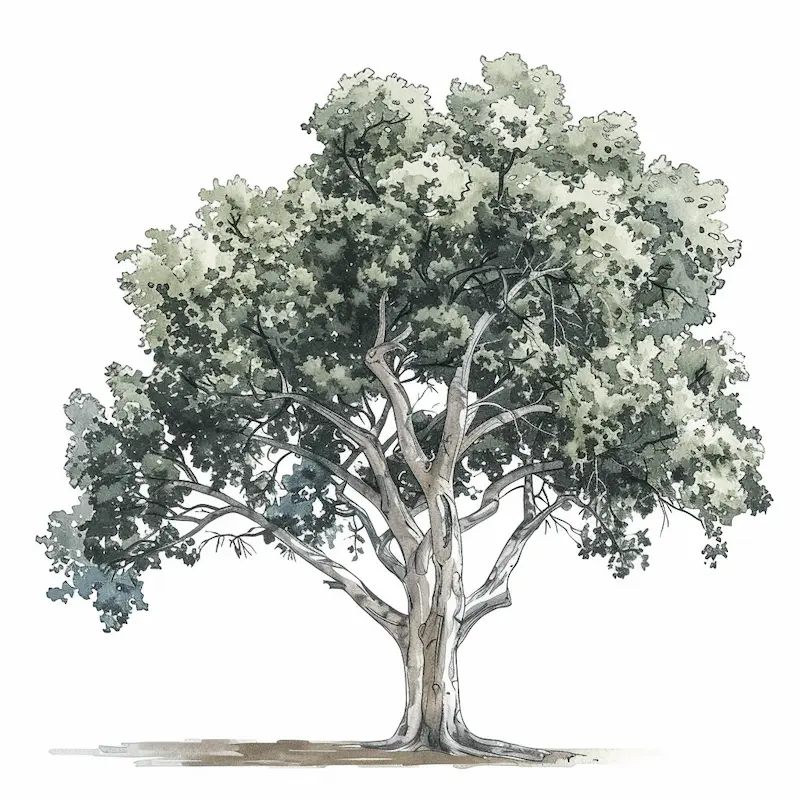
The London Plane is a hybrid tree that arose naturally from the cross-breeding of the Eastern Plane and the Western Plane. Its history in cultivation dates back to the seventeenth century, when spontaneous hybridisation was first observed in Spain and Italy. Since then, the tree has won the hearts of gardeners throughout Europe for its undemanding nature and exceptional ornamental value.
The true beauty of the London Plane unfolds throughout the year. In early spring, young foliage displays a vibrant yellow-green hue; in summer, the leaves darken, and in autumn they take on golden tones. But the real attraction is the trunk, whose bark flakes irregularly, creating a chaotic pattern of alternating grey-brown, cream and whitish patches. In summer, the tree produces delicate flowers gathered into spherical inflorescences that appear from April to May.
In the garden, the London Plane is a versatile player. Its tall crown serves perfectly for creating shaded avenues, whilst its spreading branches retain their leaves for an extended period. The tree harmonises beautifully with linden, maple and acacia, creating complex compositions in park design. The undemanding nature of the plane allows it to be grown in the central, southern and western regions of Ukraine, where it becomes a truly long-lived inhabitant of the garden.
If you are seeking a tree that is guaranteed to serve many generations, the London Plane is an excellent choice. These giants can live for 2,000–3,000 years, making them among the longest-lived deciduous trees on the planet. A young tree planted today will become a legacy for your descendants.
London Plane — planting & location
Bark exfoliates, creating a decorative mottled trunk
How to water London Plane
Water young plants regularly
Fertilizing and pruning: London Plane
Ornamental pruning for avenue plantings