Coral Bells
Over 500 cultivars of Heuchera have been developed with foliage in various colours.
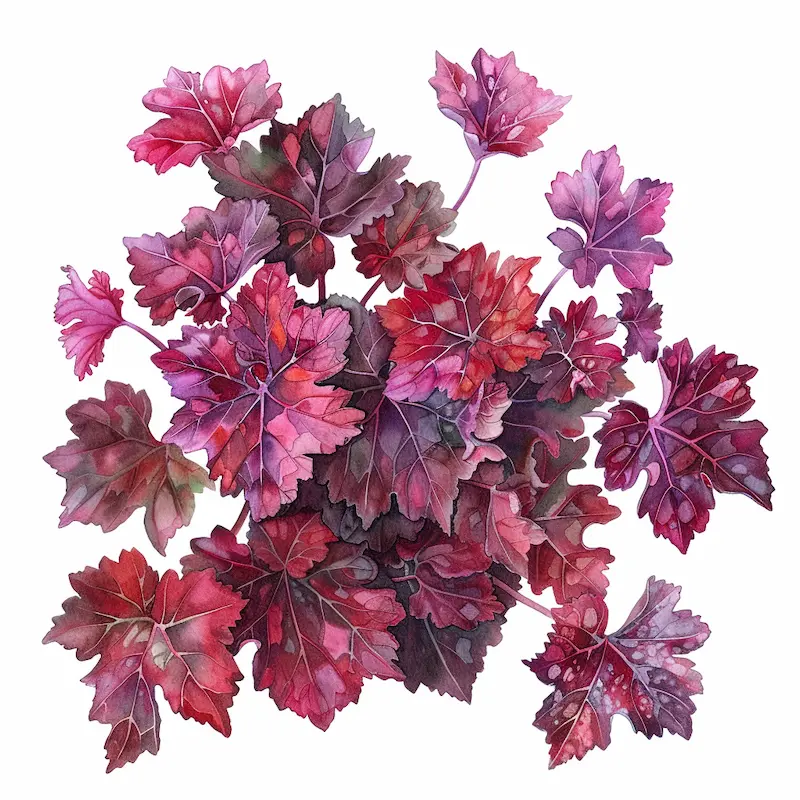
Heuchera × hybrida, commonly known as Coral Bells, is a charming perennial that transforms any shaded corner of the garden into a true masterpiece. Born from the hybridisation of North American heuchera species, it quickly won the hearts of gardeners worldwide. Plant breeders have worked on this remarkable plant for over a century, producing stunning results—we now have an enormous palette of leaf colours, from deep burgundy to silver with golden lustre.
Heuchera is truly striking in appearance: the foliage forms compact rosettes with wavy or lacey margins that change colour depending on the season and light conditions. Yet the real magic unfolds in June and July, when delicate, slender stems emerge bearing small, dainty flowers in shades of red, pink, or cream-white. English gardeners named the plant 'Coral Bells' precisely for these trembling flowers. To date, over 500 cultivars have been developed, each with its own distinctive character and charm.
In the garden, heuchera serves as a universal solution for conquering shade problems. Unlike many flowering plants, it does not complain about insufficient sunlight; rather, it reveals its most vibrant potential in partial shade. Plant it in groups in the foreground, along pathways, or as edging around tree bases. It combines beautifully with astilbe, ferns, and hostas.
English gardeners who created this culture over a century ago knew exactly what they were doing. Heuchera is not merely versatile in planting schemes—it is disease-resistant, requires virtually no special care, and its foliage looks superb all year round. This is a plant for those seeking beauty without fuss.
Coral Bells — planting & location
Ornamental foliage in burgundy, green, or silver.
How to water Coral Bells
Mulch to protect the rhizome.
Fertilizing and pruning: Coral Bells
Remove old foliage in early spring.