Phlox
The name phlox derives from the Greek word for 'flame'.
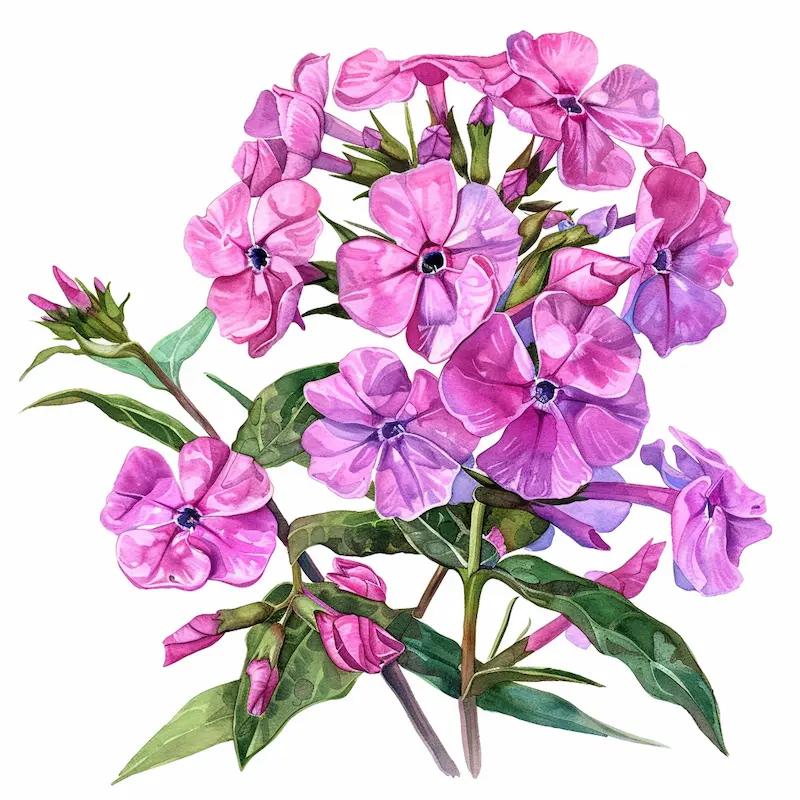
Panicle phlox is one of gardeners' most beloved plants, having arrived from North America and won the hearts of flower enthusiasts worldwide. This perennial beauty has graced gardens since the 18th century, and its popularity remains undiminished to this day. Thanks to selective breeding, there exist countless hybrid forms offering a palette ranging from delicate pink to deep violet hues, as well as pure white and vibrant red. Moreover, most varieties boast a wonderful, distinctive fragrance that fills the entire garden at the end of summer.
Externally, phlox is a graceful plant with stems densely covered in lance-shaped leaves, with the tops forming dense pyramids of small five-petalled flowers. Tall cultivars suit the back of flower beds, whilst dwarf forms can be planted at the front—it all depends on your plans. Flowering extends from July through September, making phlox a reliable partner for filling summer gaps in the garden. Among gardeners' favourite cultivars are 'David' with white flowers, 'Bright Eyes' with pink and a striking centre, and 'Barbeque' with warm orange tones.
In the garden, phlox thrives in spots with good sunlight or light shade, and appreciates moderate watering without waterlogging. This plant is universal for Ukrainian regions—from southern areas to northern latitudes. It works beautifully in mixed borders alongside salvia, echinacea and coreopsis, and is invaluable for cutting—a bunch of phlox flowers lasts in water for nearly two weeks.
Interestingly, the name 'phlox' derives from Greek and means 'flame'—apparently for the brightness and warmth of its flowers. This plant truly looks like small flames igniting the garden as autumn approaches. If you don't yet have phlox—be sure to plant it this spring, and it will reward you with abundant clusters of fragrant flowers.
Phlox — planting & location
Perennial with extended flowering period.
How to water Phlox
Avoid wetting the foliage.
Fertilizing and pruning: Phlox
Cut back to 5–7 cm from the ground in autumn.