If you have ever grown tomatoes, you have probably come across the word "desuckering" — but it is not always clear exactly what it means, whether it is truly necessary, or what happens if you skip it. Let us go through everything step by step.
What is a sucker?
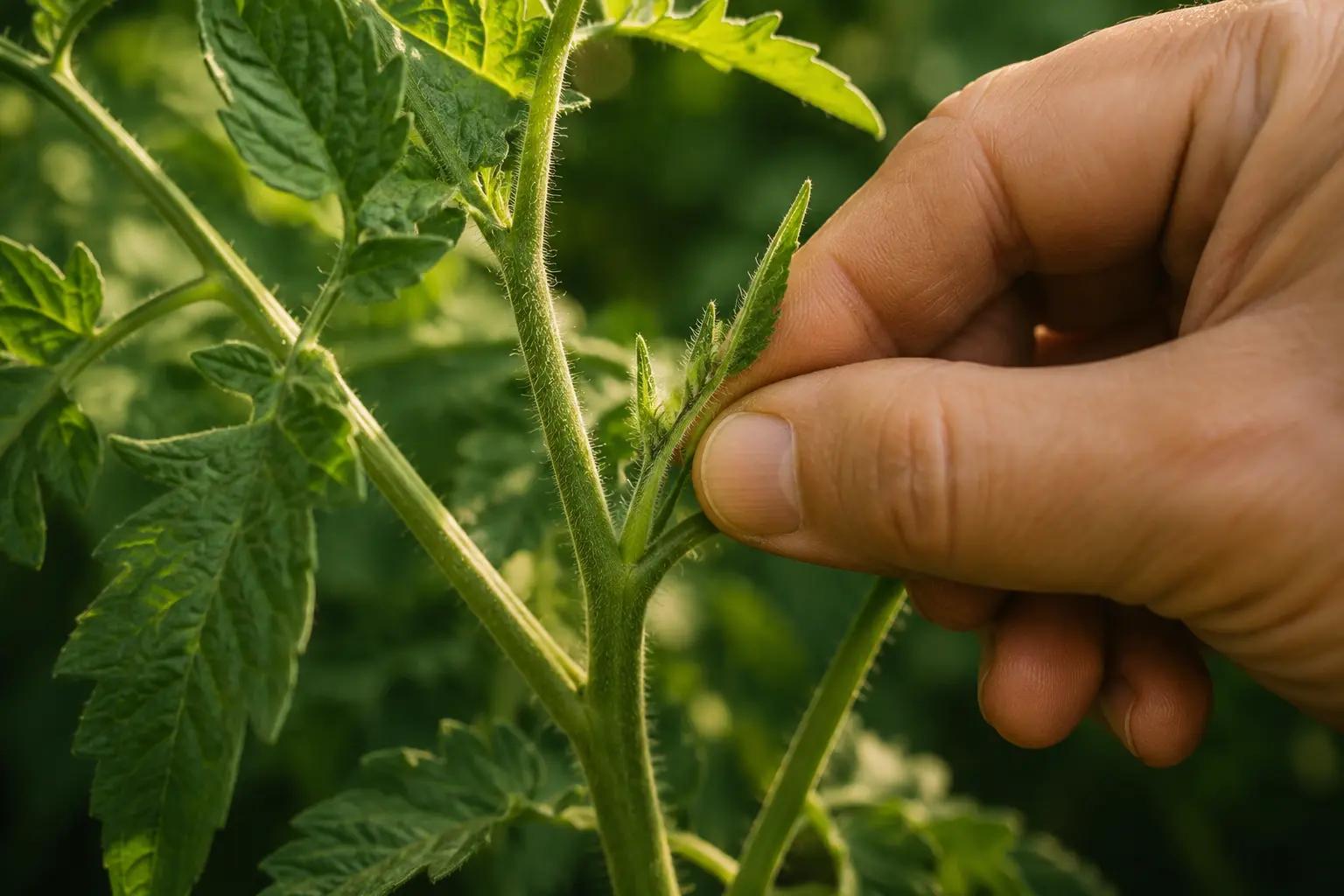
A sucker is a lateral shoot that grows from a leaf axil — the angle between the main stem and a leaf. It appears on virtually all plants in the nightshade family and has one characteristic: if left to grow, it develops exactly like the main stem, producing its own leaves, flowers and fruit.
That might sound like a good thing — more shoots, more fruit. In practice, the opposite is true. A plant has a limited supply of nutrients and energy, and if it distributes that energy across many growing shoots simultaneously, none of them receives enough. Fruits become smaller, ripening is delayed, and the risk of disease increases as the plant becomes congested.
Desuckering is the deliberate removal of these lateral shoots to direct the plant's resources where they are needed most.
Which plants need desuckering?
Tomatoes are the most important candidates. For indeterminate varieties — those that continue growing throughout the season — desuckering is essential: without it, the plant becomes a dense bush that barely fruits. Determinate varieties (compact, with limited growth) are desuckered partially or not at all, depending on the variety and growing conditions. Always read the variety description on the seed packet.
Peppers do not need as aggressive desuckering as tomatoes. Remove the main fork shoot — the one growing between the first branching — and any shoots that are overly congesting the interior. Stripping a pepper plant completely is not advisable: it is more sensitive to sunscald and needs its leaves for protection.
Aubergines (eggplants) are treated similarly to peppers — moderate removal to improve air circulation and light penetration inside the bush, without compromising the leaf canopy.
Grapevines are a separate topic, where desuckering forms part of the annual canopy management. Suckers on grapevines grow from the leaf axils of the main canes and, if left unchecked, significantly crowd the canopy, reduce airflow and lower fruit quality. Grapevine suckers are typically pinched off above the first or second leaf.
How to desuckering correctly
The most important rule: remove suckers while they are small — no more than five centimetres long. A small sucker snaps off cleanly with your fingers, leaving a minimal wound. A larger sucker will need cutting, and the larger the wound, the greater the risk of infection.
Technique by hand: grasp the sucker between your thumb and index finger at its base and pull it sideways with a firm but controlled movement. It should snap cleanly at the point where it meets the stem. If it does not snap easily, either it is still too small or you are not gripping the right point.
If the sucker has already grown beyond five centimetres, use clean secateurs or scissors. After each cut, wipe the blade with alcohol or a potassium permanganate solution — especially when moving between plants — to avoid spreading disease.
After desuckering, avoid overhead watering and keep plants out of direct sun for a few hours to allow the wounds to dry.
When to desuckering
The best time is early morning in dry weather. Plants are most turgid in the morning, suckers snap cleanly, and wounds have the rest of the day to dry before evening.
For outdoor tomatoes, begin as soon as the plant reaches 20–25 centimetres and the first suckers are visible. From then on, check plants every five to seven days: in warm weather, suckers grow quickly.
Avoid desuckering after rain or watering, and in intense heat — the plant is already under stress at those moments.
The most common mistakes
The first and most frequent: removing a leaf instead of a sucker. A leaf grows directly from the stem; a sucker grows from the axil of a leaf. If you are unsure, wait a few days — a sucker will elongate quickly and become unmistakeable.
The second mistake: leaving removed material inside a greenhouse. This is a source of disease and fungal infection. Remove desuckered shoots immediately and compost or dispose of them outside.
The third: not desuckering at all, out of reluctance to "harm the plant." In reality, timely and correct desuckering does not weaken the plant — it strengthens it, allowing it to concentrate its effort on the fruit it has already set.