Yellow Buckeye
Yellow Buckeye is considered more resistant to the leaf-mining moth that destroys common chestnut.
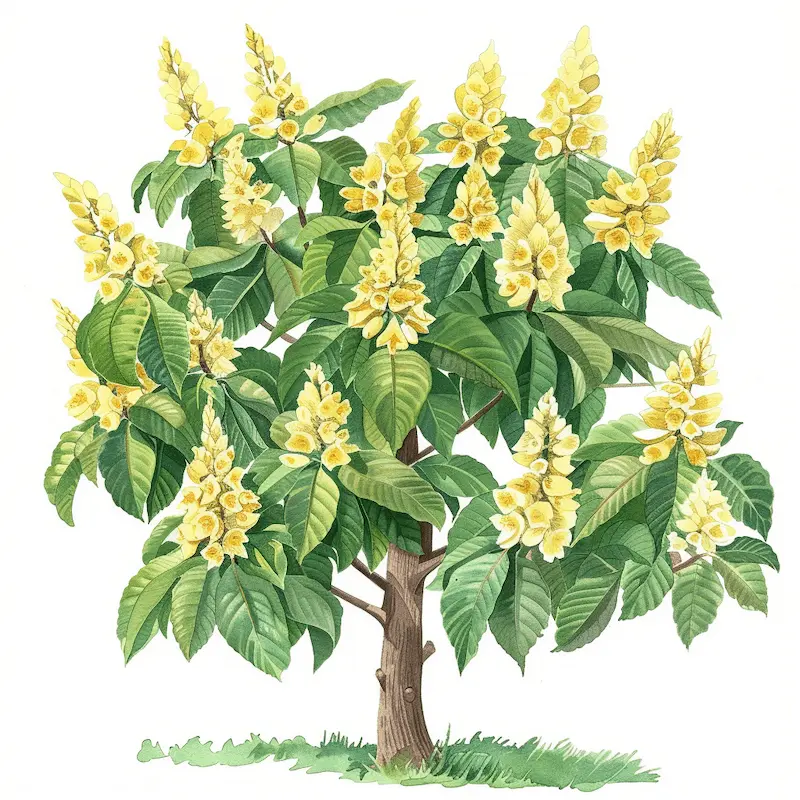
The Yellow Buckeye is native to the eastern American forests and has been a favourite among European gardeners since colonial times. This variety of buckeye stands out for its sunny yellow flowers, which bloom in May and June, transforming the crown into a spectacular display. Unlike its more popular relative, the Horse Chestnut, the Yellow Buckeye is more compact and appears more graceful, occupying a position between shrub and tree depending on growing conditions.
The foliage of this plant is pinnately compound, bright green in summer, and assumes enchanting golden-orange tones in autumn. The flowers are gathered in dense pyramidal inflorescences, attracting bees and other pollinators. The fruits—small light-brown capsules—are interesting to observe but, unlike the Horse Chestnut, lack ornamental value.
In the garden, the Yellow Buckeye serves as a temperature buffer and natural screen. It harmonises beautifully with birch, linden and sycamore maple, creating multi-layered compositions. The plant is valued for mixed tree group plantings in the central and western regions of Ukraine, where it thrives naturally.
The principal advantage of this buckeye is its relative resistance to the horsechestnut leaf miner, which devastates common chestnuts. This makes the Yellow Buckeye a wise choice for gardeners who wish to enjoy beauty without the constant fear of pests. With minimal care, the tree will remain healthy and attractive for decades.
Yellow Buckeye — planting & location
Yellow relative of the Horse Chestnut, more resistant to leaf-mining moth.
How to water Yellow Buckeye
Water young plants frequently.
Fertilizing and pruning: Yellow Buckeye
Remove only diseased and dead branches.